|
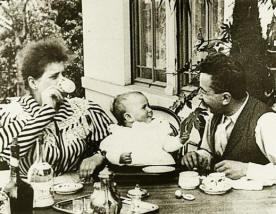
A diagonal light casts strong shadows on the
intimate urban scene in a richly decorated room. It is supposed that the
figures represent the artist's family.
Boucher was a French Rococo painter,
engraver, and designer, who best embodied the frivolity and elegant
superficiality of French court life at the middle of the 18th century.
He was for a short time a pupil of François Lemoyne and in his early
years was closely connected with Watteau, many of whose pictures he
engraved. In 1727-31 he was in Italy, and on his return was soon busy as
a versatile fashionable artist. His career was hugely successful and he
received many honours, becoming Director of the Gobelins factory in 1755
and Director of the Academy and King's Painter in 1765. He was also the
favourite artist of Louis XV's most famous mistress, Mme de Pompadour,
to whom he gave lessons and whose portrait he painted several times
(Wallace Collection, London; National Gallery, Edinburgh).
Boucher mastered every
branch of decorative and illustrative painting, from colossal schemes of
decoration for the royal châteaux of Versailles, Fontainebleau, Marly,
and Bellevue, to designs for fans and slippers. In his typical paintings
he turned the traditional mythological themes into wittily indecorous
scènes galantes, and he painted female flesh with a delightfully healthy
sensuality, notably in the celebrated Reclining Girl (Alte Pinakothek,
Munich. 1751), which probably represents Louis XV's mistress Louisa
O'Murphy. Towards the end of his career, as French taste changed in the
direction of Neoclassicism, Boucher was attacked, notably by Diderot,
for his stereotyped colouring and artificiality; he relied on his own
repertory of motifs instead of painting from the life and objected to
nature on the grounds that it was 'too green and badly lit'. Certainly
his work often shows the effects of superficiality and overproduction,
but at its best it has irresistible charm and great brilliance of
execution. qualities he passed on to his most important pupil,
Fragonard. |