French painter (b. 1848, Paris, d. 1894, Petit
Gennevilliers)
Gustave Caillebotte was a dedicated mover and shaker among
the Impressionists. He haggled and negotiated to keep the
group together through periods of fractious disagreement
and, when he had to, he rented the exhibition space, paid
for the advertising, bought frames, and hung the pictures.
Fruit, a.k.a. Display of
Fruit (Fruits, a.k.a Fruits a l'etalage.) 1880/82
Oil on canvas, 75 x 1000 cm
Museumm of Fine Arts, Boston
Still life was a consistent - if minor - features of the
Impressionist exhibitions, notably in the submissions of
Monet. Only Cezanne, however, made the genre central to his
production; for the rest, it was of secondary importance.
Le Dejeuner 1876 Oil on canvas
Prfivate Collection
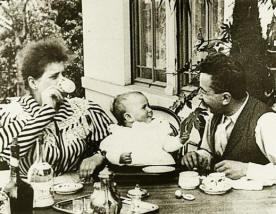
Caillebotte's painting of his mother, his brother Rene, and the
family butler in the dining room of the rue de Miromesnil home
completes the painted trilogy of family life that he exhibited
in 1876. Perhaps because of its traditional genre subject and
its smaller scale, Luncheon did not receive the
critical attentiion of the two larger scenes in the series.
Compared with the three luncheon scenes on display at the 1876
Impressionist Exhibition - Morisot's Luncheon on the Grass
(1875), Renoir's Luncheon at
the Restaurant Fouernaise, and Monet's large
decorative panel The Luncheon,
acquired by Caillebotte for his own collection - this stifling
haut bourgeois interior must have seemed out of step
with the plein-air painting associated with the
Impressionist enterprise.
Whereas Renoir depicted his
friends enjoying the nourishment of food and companionship and
Monet the quiet aftermath of a picnic in the garden,
Caillebotte painted an almost painful ritual in progress,
within a gloomy and heavily furnished dining room presided
over by Mme Caillebotte.
The Gardeners
Calf's Head and Ox
Tongue (Tete de veau et langue de boeuf)
c.1882 Private collection
In
painting a calf's head, while featuring a subject both humble
and 'ugly', Caillebotte's representation effectively works
towards a bizarre subversion of standard Realistr fare.
Focussing on the raw beef tongue and a calf's head hanging
from hooks in the butrcher's shop, Caillebotte's composition
furthers the disassociation of sign from substance begun with
the butcher's assault on the animals. Isolated, the
dismembered parts are suspended in a kind of commercial
purgatory
between death and consumption - dead matter cut off
from life and not yet transformed and revalidated as food. Yet
the pinks, mauves and reds of Caillebotte's palette fail to
connote life's blood, allowing the parts to float relatively
free of associations with a vital past and to assume an oddly
gay appearance - one thinks of Japanese lanterns and kites.
Gateaux
Poultry and Hares
Still-Life and Oysters
Anne Distel, Douglas W. Druick, Gloria Groom, Rodolphe
Rapetti, Julia Sagraves, Maryanne Stevens
Artprice.com: 306,000 listed
artists
Check the accurate prices with 3.7 million auction records &
artists’ key indices, discover the biography of emerging & renowned
artists, see detailed upcoming auctions, check 36,000 artists
signatures. Take advantage of our free
email alert on your listed artists!
Le parc Caillebotte à Yerres (Essonne, France).
Ancienne propriété de Gustave Caillebotte, peintre français à la fin du 19e.
Cet espace public remarquablement entretenu par la commune de Yerres, permet
de retrouver le charme d'une époque, une douceur de vivre.
Plaisir de se promener, aujourd'hui, sur les lieux qui ont inspirés
l'artiste.
Henri Fantin-Latour (1836-1904)
Still-Life: Corner of a Table, 1873. Oil on canvas. The
Art Institute of Chicago(Asda Turnebull Herttle Fund, 1951-226.)