|
|
|
|
home
|
|
MANET,
Edouard/ ARTISTS 1650-1899/ ART MAIN
|
original
lfff site
|
|
(b. Jan 23, 1832, Paris,
France, d. April 30, 1883, Paris)
|
film
and food
|
|
French painter and printmaker who
in his own work accomplished the transition from the realism of Gustave Courbet to Impressionism.
Manet broke new ground in choosing subjects from the events and appearances of
his own time and in stressing the definition of painting as the arrangement of
paint areas on a canvas over and above its function as representation. Exhibited
in 1863 at the Salon des Refusés, his Le Déjeuner sur
l'herbe ("Luncheon on the Grass") aroused the hostility of the
critics and the enthusiasm of a group of young painters who later formed the
nucleus of the Impressionists. His other notable works include Olympia
(1863) and A Bar at the Folies-Bergère (1882).
|
music
and food
|
|
literature and food |
|
|
 |
|
L'Absinthe
has been a bistro for decades, conveniently
sited near the Louvre and Tuileries, but since the Michel Rostang group
have taken it over and extended it, it has become something of a haute
bistro. Still relaxed, still low-key, but with a bit of Manhattan about
it as well as Paris. The dishes are bistro-style with aspiration. |
The Absinthe Drinker
1859
oil on canvas 117.5 x 103cm
NY Carlsberg Glyptotek |
|
cafe society |
The Salon rejected this painting on several
counts. The Baudelairian subject matter of a drunk offended public
morals and the loose handling and lack of definition of the painting
outraged the critics. The bottom 16 inches of the painting was added in
1867 completing the figure, adding the glass of absinthe and the bottle.
Absinthe was served from fountains placed behind the bar and was poured
onto a spoonful of sugar. By 1874 two million gallons of absinthe were
being consumed a year in France. |
 |
 |
 |
|
Eel and Red Snapper
1864
oil on canvas 38x46cm
Musee d'Orsay |
Fish and Oyster
or Still Life with Fish
1864
oil on canvas, 71 x 91cm
Art Institute of Chicago |
|
 |
|
|
|
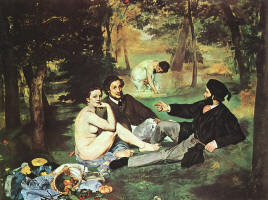
Luncheon on the
Grass (Le Déjeuner sur l'herbe)
1863
Oil on canvas,
81 x 101 cm
Musee d'Orsay
|
|
|
The active spirit of independance in
Impressionism, if not its style, may be considered to date from this
famous work, refused by the Salon in 1863 and exhibited, under the title
of Le Bain at the Salon des Refusés of the same year. It is the larger
of Manet's two versions of the subject, a smaller and freer version
being in the Courtauld Institute Gallery in London. According to Antonin
Proust, the idea of the picture suggested itself to Manet when they were
watching bathers at Argenteuil. Manet was reminded of Giorgione's
Concert Champêtre and determined to repeat the theme in clearer colour
and with modern personnel. A closer likeness of composition has been
found in an engraving by Marcantonio of a group of river gods, after a
now lost original by Raphael of The Judgement of Paris. An Old Master
element of formal arrangement remains to distinguish it from an
essentially Impressionist work and yet as well as being ostensibly set
in the open there are various hints and suggestions in light and colour
of fresh possibilities in open-air painting. The furious outcry it
caused as the principal exhibit among the Salon rejects was based on the
alleged indecency of two fully-dressed men appearing in the company of
the naked female bather (an accusation no one had thought to make
against the comparable juxtaposition in the work attributed to Giorgione).
But the respectable persons represented in sedate conversation were
Manet's favourite model, Victorine Meurend (whom he also painted as a
toreador), his brother-in-law, Ferdinand Leenhoff, and Manet's younger
brother, Eugène.
Public hostility not only helped to make Manet a hero in the eyes of the
young painters but brought together in his support the group from which
the Impressionists emerged.
How far Claude Monet was impressed by the picture may be gauged from the
fact that in 1865 he decided to paint his own Déjeuner sur l'Herbe,
though simply as a group of picnickers without the element of dress and
undress and in more natural attitudes than the figures in Manet's
composition. Only a fragment of this large work has survived but a
Déjeuner sur l'Herbe by Monet in the Hermitage, Leningrad, is apparently
a replica---not so grand a work as Manet's but with more veracity of
informal, sun-lit grouping. Manet himself changed the title of his
painting to Le Déjeuner sur l'Herbe at his exhibition of challenge and
protest in 1867. It came to the Louvre as part of the Moreau-Nelaton
Collection in 1906. |
|
 |
 |
|
Edouard Manet, (1832-1883)
The Lemon, 1880
14 x 22 cm
Oil on canvas
Musee d'Orsay, Paris |
|
|
 |
|
|
Le
Bar aux Folies-Bergère 1881-82 Courtauld Institute Galleries, London
|
|
|
|
This sparkling portrayal shows extensive use of peinture
claire, a technique Manet himself evolved. |
|
|
|
|