|
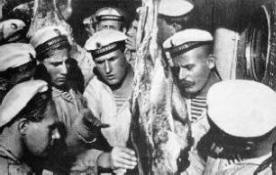
In the first great international success of the new Soviet
propaganda cinema, Eisenstein's BATTLESHIP POTEMKIN starts
with a truly dialectical food drama. The film's opening
section is called 'Men and Maggots' and it is the crew's
complaint that their meat is crawling with maggots -
rejected by an officer, despite the close-up evidence -
which sparks a mutiny.
To call BATTLESHIP POTEMKIN a visionary and technical
landmark in the history of world cinema is overly redundant
since nearly every analysis, conversation or review of the
film refers to it as such. However, this respectful nod of
awe is also appropriately necessary. Director Sergei
Eisenstein's flavourful symbolism, starkly gorgeous visuals
and rousing passions are phenomenal accomplishments.
Nearly every scene looks like a beautiful photographic
masterpiece when separated from the action, and when viewed
in motion is nothing short of a fluid, poetic gorgeousness.
Any film lover unfamiliar
with the legendary "Odessa stairs" massacre is ignorant to
the powerful potentials of the film medium. There are few,
rare moments in film history comparable to the stark
brutality of this sequence. (The Ford Theatre sequence in
"Birth of a Nation" is the only equal to this.) The perfect
symmetry of the soldiers declining the stairs and
symbolically firing down upon the civilians is jarring in
its effectiveness. The most widely praised moment of this
sequence is a mother's shooting which sends her child
careening uncontrollably down the stairs in a stroller.
The civilians who attempt to stop the carnage are mowed down
under the fire of the advancing troops.
Following the "Odessa stairs"
sequence, the sailor-controlled Potemkin sails forward
heroically to face an advancing fleet commissioned to sink
the mutinous ship. While the final moments of the story may
be drawn-out, the tension is undeniable. The film is
famous for its political stance against an autonomous
Russian government, its brilliant use of montage editing and
symbolism, and preference towards group action to highlight
the protesting nature of the film, as opposed to personal
characterizations of the characters. However, these
famous factors are only necessary when studying the
mechanics of the filmmaking. "Battleship Potemkin" is a
tired subject for familiar film students and knowledgeable
film critics, but for unfamiliar viewers, Sergei
Eisenstein's masterpiece is nothing short of fiery,
shattering drama. |