|
Understandably, your immediate
response is likely to be a literal and not an intellectual one.
But unlike cookery programmes, whose main purpose - entertaining
apart - is to teach you how to feed your body, the makers of
foodie films are more intent on feeding your mind.
In contemporary cinema,
screenwriters and directors have produced a powerful and
thought-provoking body of performance art - in which food
plays a key role.
This role has never been properly
acknowledged or registered. For many of these film makers,
points out Cambridge lecturer Jennifer Wallace, ‘food is
never unambiguously material and its metaphorical
possibilities are endless.’
Sometimes, the use of food in films
is marginal, little more than a prop or set piece. The meal
depicted simply as an ordered social ritual set the stage
for the unravelling of a shameful family secret in Danish
director Thomas Vinterberg’s FESTEN,
which premiered at The London Film Festival in November 1998.
In others, it plays a hidden role,
subtly illustrating a particular age or social gathering. Take
Martin Scorsese’s THE AGE OF INNOCENCE
(1993), a study of prejudice in America’s repressed upper class
society of the late 19th century, in which the director utilises
food and etiquette to depict a social jungle.
Alternatively, food can become ‘the
star of the show,’ the centre of a ‘cinematographic
plate.’
Film studies professor Ian Christie goes even further:
‘Cinema itself is a kind of consumption, hoovering up reality
and feeding it to us in bite-sized chunks.’
At the opposite end of the spectrum,
there are a rash of ‘anti-food’ films based on a denial
of food and drink, such as in LAWRENCE
OF ARABIA (1962), the
DISCREET
CHARM OF THE BOURGEOISIE (1972) or GANDHI (1982).
During the XXth century, typically
and traditionally, food or its scarcity has been featured as a
graphic metaphor for poverty, wealth, greed, lust, sex, loss,
death or even contradiction.
Charlie Chaplin fans will recall his
1925 American masterpiece,
THE GOLD RUSH, which centres
around the hunger of its main character, a tramp, and his
fixation with food. Two classic scenes - the one where he cooks
and ‘eats’ a boot with laces as spaghetti, and another where he
makes two bread rolls dance in a play for a girl - draw
attention to his poverty and his need for sex.
If ‘famine’ marked the portrayal of
food in the 1920s, then in the UK, ‘feast’ was the theme of the
next decade. Alexander Korda’s PRIVATE
LIFE OF HENRY V111 (1933) with its hedonistic,
banqueting king representative of a sentimentalised Merrie
England is typical of the genre.
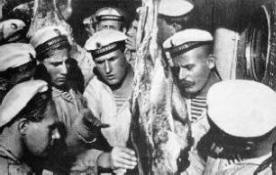
During the Second World War, film
makers concentrated on the population’s pressing need to
survive. With the development of sound, the cinema became
an essential educational tool in disseminating messages about
rationing, household economy and nutrition.
But food can also be an
expression of religion, myth, ritual, ordinary life or even
human goals.
It took till the 1980s for film
makers to regard food as important enough
to depict as an affirmation of life
and celebrate it for its own sake, as well of course, for
the creative skills of the cook.
Decades previously, food had been
depicted in the form of lavish feasts served in court to the
nobles and royalty, and became a metaphor for riches and
wealth, from which the poor peasants were excluded
and could only look on in envy. Director Gabriel Axel’s
treatment in BABETTE’S FEAST
(1987) marked a dramatic departure.
By showing that food as pleasure
is not just the prerogative of the privileged, Axel
reflected the sociological drift away from the privileged
classes towards a meritocracy. Babette’s banquet was classy but
classless - haute cuisine that could be enjoyed for its
own sake, whoever you are.
Telling scenes show the Count and
the kitchen boy enjoying the same priceless vintage wine.
More recently,
EAT DRINK MAN WOMAN
(1994), BIG NIGHT (1996)
and SOUL FOOD
(1997) all feature food that ordinary people recognise as
everyday home fare and use that as part of the cinema experience
to make another statement.
In these films, the meals are
closely bound up with messages about family unity or disunity
and the striving for perfection. But what they all have in
common is that the food depicted is no longer alien to them and
is part of their everyday lives. Directors for the first time
are putting food centre stage as an actor in its own
right.
Director Ang Lee took 18 hours to
get the food on the table on the first day’s shoot of EAT DRINK,
and the film boasted a cast of over 100 dishes.
Likewise in
BIG NIGHT, the piece de resistance was an 11 kilo
kettle drum pasta pie called a timpano, which took two
people to carry. The food stylist had to create over 30 of
them.
Director and actor Stanley Tucci was
anxious to get away from Italy’s portrayal as a nation of
mafiosi.
So BIG NIGHT cherishes the
ideal of the truly professional, perfectionist chef and
restaurateur dedicated to his art and to introducing the
best of their homeland to the New World. That includes the way
their food should be served and eaten.
All credit for its authenticity, due
to its two co-stars who trained for the cooking scenes for
nearly a year in actual restaurants. It is the perfect food film
for the 1990s, the era of chefs as heroes.
The ritual of the family meal
is an essential cultural marker, graphically and sometimes
painfully illustrated in films like Steven Spielberg’s
SCHINDLER’S LIST (1994), George Tillman Jr’s Afro-American
SOUL FOOD (1997), and Martin
Scorsese’s Italo-American GOODFELLAS(1990),
where it may be the only unifying and constant element available
to an immigrant clan trying to assert their identity in a
foreign culture.
But in Scorsese’s gangster movie, it
serves an additional purpose; it is a sign of status and
‘arrival’, the fruits of the good life, and it
expresses mastery. Hence the fastidious attention of the
mobsters to ensure culinary perfection. Even in prison, they
insist on a gourmet menu that includes fresh lobster, the best
wine and garlic sliced so fine “it liquefies in the pan with
just a little oil.”
Movies connecting food with sex
are legion. Take that archetypal scene in Tony Richardson’s
TOM JONES (1963), where a
simple tavern meal became the foreplay to a raunchy love-making
session and the food itself is merely a prop to express their
lust.
The director pans back and forth
between Albert Finney as Tom and Joyce Redman as Mrs Waters as
they feast on huge bowls of soup, suck lobster meat suggestively
from its shell, dive into baked chicken in between a salacious
lip-rubbing wishbone come-on, gnaw on roasted lamb shanks and
lewdly slurp down that
classic aphrodisiac
- oysters.
But oysters aren’t the only dish to
spark lust on the silver screen. The late Juzo Itami uses egg
yolks in TAMPOPO to stage what
must be cinema’s sexiest scene ever.
Let’s end, appropriately, with food
on film as a metaphor for death, decay and excess,
unforgettably portrayed in Marco Ferreri’s
LA GRANDE BOUFFE (1973), known as
BLOW OUT in the UK.
The story of four men and one woman
who assemble to guzzle the mother of all banquets in a frenzied
orgy of debauch and self-destruction, it has been epitomised as
a perfect specimen of the ‘cinema of disgust, ’ a
metaphysical rejection of consumer society.
Similarly in Peter Greenaway’s
THE COOK, THE THIEF, HIS WIFE AND HER
LOVER (1989). A restaurant dressed as the set for a
Jacobean tragedy and a cavernous hell’s kitchen are the backdrop
to a parade of the basest aspects of human nature.
The cook as artist and creator
serves as a foil to the thief as ignorant glutton, paralleling
the feeling that many chefs must have of sweating over a superb
dish for customers who have more money than taste.
Note the prevalence of black
foods like caviar and truffles and the association of this
colour with death. The film climaxes with cannibalism, the
ultimate link with death, and the dissolution of the meal as
order into chaos.
BIBLIOGRAPHY/FURTHER READING
Eds. Sian Griffiths and Jennifer
Wallace,
Consuming Passions: Food in the Age of Anxiety, ch.
Feasting in the Dark by Ian Christie, Mandolin, Manchester
University Press, 1998, pp183-191
Susan Wolk,
Director of London Food Film Fiesta, and Maria Jose Sevilla, TV
cook and author
A modified version of this article appeared in
Rotana
Magazine, July 2008 |