As the world’s countries become
more international – and homogenised – and as computers
propel its citizens into cyberspace, nations grow more
deeply resolved to cling fiercely to their cultural
identities.
Hardly surprising, then, when famous
old British brands such as Marmite celebrate their
centenary, odes should be written and hats thrown into
the air, with the same degree of joy accompanying the
birth of a first-born.
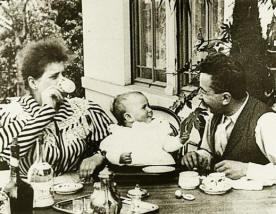
Most of us born post-war fondly
remember being regularly fed Marmite soldiers for
breakfast. Those not reared on this tasty offering
should know that Marmite soldiers are pieces of toast or
plain buttered bread cut into strips and spread with a
thin layer of Marmite. One of the standard
parent-approved games to play with Marmite soldiers was
to ‘dunk’ them into the yolk of a soft-boiled egg.
Today’s generation are probably much more likely to
indulge in the frivolous pastime of Marmite Beating,
like fan Peter Kingsland, who told John Peel hosting a
BBC Radio 4’s Home Truths programme that what you
have to do is place a small dollop of marmite on the
side of your breakfast plate and gently beat it with a
knife until it turns from brown to light brown and
eventually to white. ‘Oh yes it does,’ he assured him,
in case he thought it was a hoax.
However, he warned that ‘this is an activity only to be
undertaken as a student or if you are detained at Her
Majesty's Pleasure for some considerable time, as it
literally takes hours to reach the ultimate goal of
turning your marmite white!’ Apparently, there is
also a Marmite Beaters Club for people who had achieved
the requisite shade of white.
What is it about this dark brown sludge that induces
such love – or, it must be said, loathing, because there
are as many people who hate the stuff, as adore it? It’s
certainly a marketing coup for Unilever, which manages
to sell 23.5 million pots a year of what is merely spent
yeast - used by brewers to ferment sugars into alcohol
- and has also spawned
a variety of imitators worldwide, like Australia, which
has its own devotees of Vegemite and Promite.
Firstly, Marmite is good for you. The discovery of
vitamins in 1912 did much to boost its popularity.
It
has a high natural B-vitamin content (prevents anaemia),
as well as thiamin, riboflavin (healthy skin and enzyme
regulation), niacin (both for energy) and folic acid
(important during pregnancy to help prevent spina bifida
in unborn infants) and so can form a reliable part of
the everyday family diet. It is also approved by the
Vegetarian Society as being 100 per cent vegetarian.
Secondly, it is versatile. As well as being enjoyed as a
tasty savoury spread on toast or bread, a teaspoon of
Marmite can be added to soups, casseroles, and almost
any savoury food to impart a rich flavour.
It
also has excellent storage properties - large jars will
last years after opening without going off.
Not
until Louis Pasteur's time were the secrets of living
yeast unlocked. A German chemist named Liebig discovered
that the yeast waste left over from brewing beer could
be easily digested and made into a concentrate,
resulting in a protein-rich paste with a more or less
‘meaty’ flavour. So Marmite is actually a European, not
British, invention! But for once, the Brits were the
first to make it commercially viable.
The
yeast extract used in British Marmite comes from
breweries in the Burton-on-Trent area. Burton has been
the home of Marmite since the patent was first acquired
in 1902 and the Marmite Food Extract Company Limited was
born. That same year Edward VII was crowned.
It is thought that
Marmite is named after marmite, a French stockpot
or cooking pot, similar to the one pictured on the front
of the jar. In French, it is pronounced ‘mar-meet’.
Alternatively, the product may have been named after a
famous French soup, Petite Marmite.
The
spread was sold in small earthenware pots from the
outset, but towards the end of the 1920s, plans were
drawn up to switch to glass jars with metal lids.
By the outbreak of the First World War, Marmite was an
established brand, recognised for its nutritious
properties as an essential food supplement. It was
therefore ideal for troops serving overseas to combat
the outbreak of beri-beri and other deficiency diseases.
At the outbreak of the Second World War, the Marmite
brand again went into battle, and on the home front
housewives were encouraged to spread it thinly and to
'use it sparingly just now'.
In
the 1950s, after 50 years of selling Marmite, the
company was justly able to claim that it was a product
handed down from generation to generation. The
advertising theme at this time focused on the benefits
for children.
By
now, Marmite had reached cult status, aptly recognised
by the outcry when the jar lid was upgraded from metal
to plastic in 1984. The company bowed to popular demand.