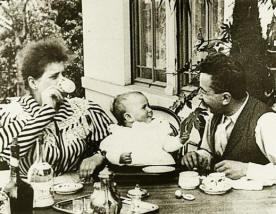
San Francisco-born American literary figure,
who was a close associate of the author
Gertrude Stein (1874-1946), her secretary, cook, and
confidante in Paris in her literary salon. Toklas was a chain smoker
with a slight mustache, Gypsy earrings, and manicured nails. After
moving to Paris, Stein met Alice B. Toklas in 1907; she called her
"Pussy", and Gertrude was "Lovey" to Alice. From 1903 to 1909 Stein
lived with her brother Leo, who left the couple to continue together in
the early 1910s. Their apartment in the Rue de Fleurus became a famous
meeting place for artists and writers.
"To cook as the French do one must
respect the quality and flavour of the ingredients. Exaggeration is
not admissible. Flavours are not all amalgamative. These qualities
are not purchasable but may be cultivated. The haute cuisine has
arrived at the enviable state of reacting instinctively to these
known principles." (from The Alice B. Toklas
Cookbook , 1954)
Alice Babette Toklas was born in San
Francisco into a middle-class Jewish family. She was educated at public
schools and at the University of Seattle and the University of
Washington. After the death of her mother, Toklas returned to San
Francisco to take care of her father and brother. Her life changed at
the age of 29 when she decided to go to Paris at the suggestion of Leo
Stein. There she met Gertrude Stein: "She was a golden brown presence,
burned by the Tuscan sun and with a golden glint in her warm brown
hair."
In 1908 Toklas began typing manuscripts
for Gertrude Stein, and by 1909 she was part of her life. They moved in
1910 into 27, rue de Fleurus, which become their famous home. Leo left
them in 1913. An excellent cook and fond of paintings, furniture,
tapestry, houses and flowers, Toklas took soon the reigns of Stein's
household. Later she published THE ALICE B. TOKLAS COOKBOOK (1954),
her first book. "The French like to say that their food stems from their
culture and that is has developed over centuries," wrote Toklas. "We
foreigners living in France respect and appreciate this point of view but
deplore their too strict observance of a tradition which will not admit
the slightest deviation in a seasoning or the suppression of a single
ingredient."
Stein, who has been considered the
"masculine" part of the relationship, was the soothing and listening
partner; Alice called her a "strong-strong husband". However,
A Movable
Feast (1964), Hemingway's memoir of his years in Paris after World War
I, gives the impression that Toklas commanded Stein outside the saloon.
Stein wrote an erotic poem 'Lifting Belly,' to Toklas between 1915 and
1917 - it was not published in Stein's lifetime. Socially it was at that
time accepted that women shared homes, but physical relationship was
something else. Another poem to Toklas, inspired by Cubism, was built
around four sentences: "Do you really think I would yes I would and",
"Do you really think I could, yes I could", "Do you really think I
should yes I should", and "Do you really think I do love all you with
all". Other sides of the crystal-like poem are left "un-visible" - perhaps
including the verbs "must" and "ought".
During the period Toklas and Stein were
together, they wrote each other little love letters. Alice was an early
riser, and Gertrude, who wrote late into the night, left her tender,
passionate notes to cheer up her mornings. "Baby precious Hubby worked
and / loved his wifey, sweet sleepy wifey, / dear dainty wifey, baby
precious sleep," Stein once rhymed.
Toklas gained wide attention with the
publication of The Autobiography of Alice. B. Toklas ,
1933), which is actually Gertrude Stein's memoirs. It records Toklas's
first-person observations of Stein's life and her friends, among them
Ernest Hemingway, Sherwood Anderson, Pablo Picasso, Henri Matisse, and
Georges Braque. The book appeared first in an abridged form in The
Atlantic Monthly magazine. Stein's writing style is conversational and
clear. Toklas notes how many wives of geniuses she had to sit with while
Stein was with their husbands. The book also tells of the visit Toklas
and Stein made to Alfred North Whitehead's home in England and of their
wartime involvement with the American Fund for the French Wounded. They
visited hospitals and were later decorated by the French government.
When the memoirist James Lord visited Toklas after Stein's death, he
noticed for his surprise that "Miss Toklas liked to talk. She did it
well, without restraint and at length. But she enjoyed being talked to
as well..." (from Six Exceptional Women, 1994)
According to Estelle C. Jelinek, Toklas's
presence as the narrator legitimized Stein's role as memoirist. Placing
Toklas, the most important person in her intimate life, in the centre of
the autobiography, she could pay homage to their story. Toklas is the
observing partner, not the directly observed, but at the same time Stein
controls the picture she gives of herself: "There I went to see Mrs.
Stein who had in the meantime returned to Paris, and there at her house
I met Gertrude Stein. I was impressed by the coral brooch she wore and
by her voice. I may say that only three times in my life I have met a
genius and each time a bell within me rang and I was not mistaken, and I
may say in each case it was before there was any general recognition of
the quality of genius in them. The three geniuses of whom I wish to
speak are Gertrude Stein, Pablo Picasso and Alfred Whitehead."
Stein's book provoked an attack by other
Parisian writers.
Stein died in 1946 and Toklas twenty-one years later. Toklas's own
account of her life with Stein appeared in the impressionistic WHAT IS
REMEMBERED (1963). Their last conversation in a Paris hospital has been
much quoted: "... What is the answer? I was silent. In that case, she
said, what is the question" After Stein died during surgery, Alice
cherished Stein's reputation. In the end she found Catholicism, stating
that she wanted a ticket into the afterlife, since she considered Gertude immortal
and she would be reunited with her in Heaven. Toklas died
on March 7, 1967. She was buried beside Stein in Le Père Lachaise
Cemetery, Paris.
The Alice B. Toklas Cookbook came out
when Toklas was 77. It contained 300 recipes of such dishes Artichokes
Stravinsky, Gigot de la Clinique and Breen Peas à la Goodwife. Many of
the receipts are practical, if rather advanced. The book became famous
principally because of one recipe, Toklas's Haschich Fudge, originally
given by a friend. It was not printed in the first American edition, but
was included in the British edition. Toklas's close friends assured that
the writer herself had not tested the recipe, and she did not realise
what the ingredients were. AROMAS AND FLAVORS: OF PAST AND PRESENT
(1997) presented over two hundred recipes and practical and
philosophical notes on cooking, starting from frozen aiolli and
anchovies in poultry and game dishes.
For further reading:
Baby Precious
Always Shines, ed. by Kay Turner (1999);
Lesbian and Bisexual
Fiction Writers, ed. by Harold Bloom (1997); 'Exotic Autobiography
Intellectualized' by Estelle C. Jelinek, in 'The Tradition of Women's
Autobiography (1986);
The Biography of Alice B. Toklas
by Linda
Simon (paperback, 1991);
The Grave of Alice B. Toklas by Otto
Friedrich (1989);
Gertrude Stein and Alice B. Toklas: A Reference
Guide by Ray Lewis White; Roman Spring of Alice Toklas by Donald
Windham; Staying on Alone: Letters of Alice B. Toklas (ed. by Edward
Burns)
Selected works:
- THE ALICE B. TOKLAS COOKBOOK, 1954
- WHAT IS REMEMBERED, 1963
- STAYING ALONE: LETTERS OF ALICE B.
TOKLAS, 1973
- BABY PRECIOUS ALWAYS SHINES:
SELECTED LOVE NOTES BETWEEN GESTRUDE STEIN AND ALICE B. TOKLAS, 1999
(ed. by Kaye Turner)
|
First published in 1954,
The Alice B.Toklas cookbook
is one of America's great works of recollection,
culinary and otherwise. Toklas lived, cooked, and kept house
in Paris and rural France with her companion, Gertrude
Stein, from 1908 until Stein's death in 1947. During that
time she cooked for and shared food with friends, including
Pablo Picasso, Ernest Hemingway, and Thornton Wilder,
accumulating recipes for the simple and haute bourgeois
dishes compiled in the book. She also saw and remembered
all, from life in the high bohemian circle she and Stein
occupied; to France during two world wars; to the United
States, visited in the '30s; to summers passed in a
paradisiacal country retreat at Biligin in France. These and
more Toklas depicts vividly and acerbically, all viewed
through the prism of food and good eating. Woven within
chapters such as "Dishes for Artists," "Food in French
Homes," and "The Vegetable Gardens at Biligin," the 300
recipes run the gamut from hors d'oeuvres and salads to
breads, entrées, drinks, and sweets. Original (and sometimes
whimsical) dishes like Stuffed Artichokes Stravinsky, Gigot
de la Clinque, and Bavarian Cream Perfect Love appear among
more traditional offerings, such as Boeuf Bourguignon,
Chicken à l'Estargon, and Green Peas à la Goodwife. Many of
the recipes (which are written in abbreviated-narrative
style) will be attempted only by adventurous cooks with time
(and, in some cases, money) to spare. The rest of us will
enjoy reading the recipes, the droll reminiscences, and the
fantasizing about a time when the dishes' creation could be
relatively commonplace. The tour of this era and its food,
by one of literature's great cook-writers, is obligatory
reading.
Arthur
Boehm |