|
|
|
|
home
|
|
FOOD AND
PHOTOGRAPHY/ MAIN ART
|
original
lfff site
|
|
With the invention of photography in
1839 food found itself before the camera's lens. Occasional still
lifes of food and photographs of people eating and drinking appear among
the many portraits and architectural views made during photography's
first decade. Humbert de Molard's 1846 calotype,
"Men dressing a hog," is one of the earliest photographs taken
through a gastronomic lens. It is obviously posed, a sort of tableau vivant,
reflecting both a painterly style and the long exposure that was
required.
As cameras became more portable and
lenses and emulsions faster or more light-sensitive, a journalistic
approach to food began to emerge. Carlo Naya's "Donkey
drivers," made in 1876, shows boys who, having stopped to eat, seem
to have been stumbled upon by a Western photographer looking for an
exotic subject. Naya probably posed his subjects, but his exposure
time was likely to have been much less than Humbert de Molard's, and the
effect is more journalistic than painterly. The slight blurring
around the fire itself of A.C. Vroman's image of
Hopis round a campfire (1901) suggests that, although at first
glance it looks posed, he found the group of people exactly as we see
them.
|
film and food
|
|
music and food
|
|
artists' films |
|
contemporary food photography
|
 |
|
|
|
The journalistic approach to food and eating
occurs repeatedly in Twentieth Century photography. Nothing
illustrates the human condition more clearly than the interrelationship
of people and food immutably fixed in the still photograph. To
understand, one need only examine two powerful images: Willy Georg's
photograph made in the Warsaw Ghetto in 1941, and Cartier-Bresson's 1938
picnic on the banks of the Marne.
|
|
|
|
 |
|
|
Food frequently appears in fashion and
art photography. Sometimes it may be used simply as a prop.
Irving Penn photographed two models casually lounging over lunch (1950).
Though their lunch is in the very centre of the photography, the eye
focuses on the models because of their striking poses. On other
occasions, food may be the focal point, if not the actual subject, such
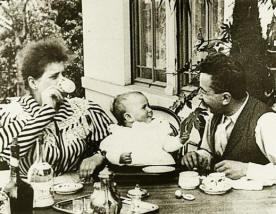
as the frozen foods in Penn's 1977 photography. The fish add a
surreal element in Diana Blok's "Portrait of my father and mother,
1987," while the mundane is both repellent and fascinating as
captured by Richard Avedon (1970).
|
|
|
|
|

Photo: Helmut Newton
Poem:
Thomas Lux |
|
The development of colour photography and
sophisticated methods for reproducing colour photographs in books and
periodicals led to its widespread use in cookbooks and advertising.
The studio photographer who illustrates cookbooks, food magazines and
advertising, produces realistic or even idealistic treatments.
This 'toothpaste and mouthwash' dessert is the creation of Paul Kitching,
at Juniper, in Cheshire. But it's not as crazy as it looks - in fact,
it's only a clever reworking of the classic strawberry. meringue and
mint combination.
|
 |
|
 |
|
From a few laboriously produced still
lives, food became a subject, and sometimes a speciality, for many
photographers. Today, like other photographic genres, food
photography is omnipresent, often taken for granted and only as far away
as the nearest library, bookstore or newsstand.
by Kathy Wachel, Rijn Templeton, Cynthea
Mosier, and Jody Beek.
|
|